Journal
Is it normal to hate your side profile? Why photos and people disagree
Disliking your side profile is common. Learn why photos distort it, how others actually see it, and what to check before a consultation.
 Claire Winslow
If a photo of your side view makes you wince, you are in large company. Many people say the profile is the angle they like least, and some avoid it in pictures altogether. The useful question is not whether the feeling is normal, but what exactly you are reacting to.
Most people who search this are weighing a decision. Some wonder whether a nose, a chin, or nothing at all is behind the discomfort. This guide helps you sort that out in order: why the profile feels worse than other angles, what a labeled example shows, and what to ask a specialist.
1. Why the profile feels worse than it looks
You rarely see your own side view. A mirror shows the front, and a phone camera held at arm length shows a wide angle that exaggerates whatever is closest to the lens. When a profile photo finally appears, it is unfamiliar, and unfamiliar tends to read as wrong.
Three things push the feeling further:
- Lens distance. A phone held close enlarges the nose and shrinks the chin, because features nearer the lens grow in the frame.
- Head tilt. A chin tipped up or down by a small amount changes how long the nose looks and how strong the jaw line appears.
- Mirror habit. You are used to your flipped face. A true profile is not flipped, and small asymmetries become obvious.
Other people meet you in motion, at normal talking distance, mostly from the front and three quarters. A frozen side shot is the view they see least. That gap between what you notice and what they notice is the core of this topic.
2. Separate the parts of the profile
“I hate my profile” usually means one of a few specific things. Naming it makes a consultation far more productive, and it may show that the issue is smaller than it feels.
The nose. Look at the line from the bridge to the tip. Is there a bump, a scoop, a tip that points down, or a tip that sits very forward? Our model has a slim, straight nose with a high bridge, which gives a clean line from the brow to the tip.
The chin. Check how far forward the chin sits compared with the lips. A chin that sits slightly back can make a nose look larger, even when the nose itself is in good proportion. Our model has a narrow chin that sits a little behind the lower lip.
The neck and jaw line. A soft angle under the chin can blur the profile whatever the nose and chin are doing.
The forehead and lips. These set the frame. Changes to them are outside what this guide covers, so we leave them alone.
A fair test is to ask which single part you would change if you could only change one. If the answer comes easily, you have a starting point. If it does not, the discomfort may come from the photo rather than the face.
3. A labeled example on one face
The comparison below uses our model. In the original, the nose forms a straight, high line, and the chin sits just behind the lower lip. In the simulation, the nose is left alone and only the chin moves forward, a clear but natural step a specialist could discuss.
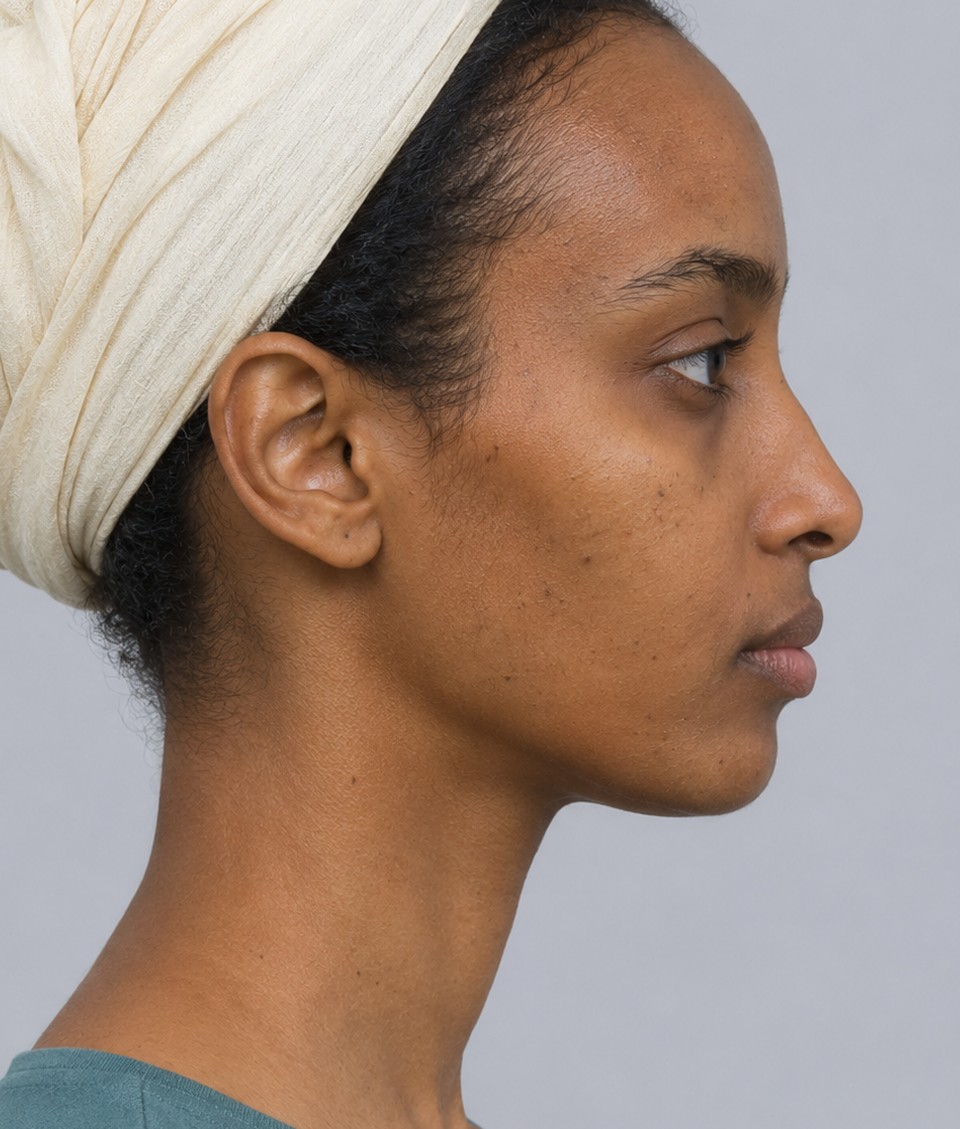
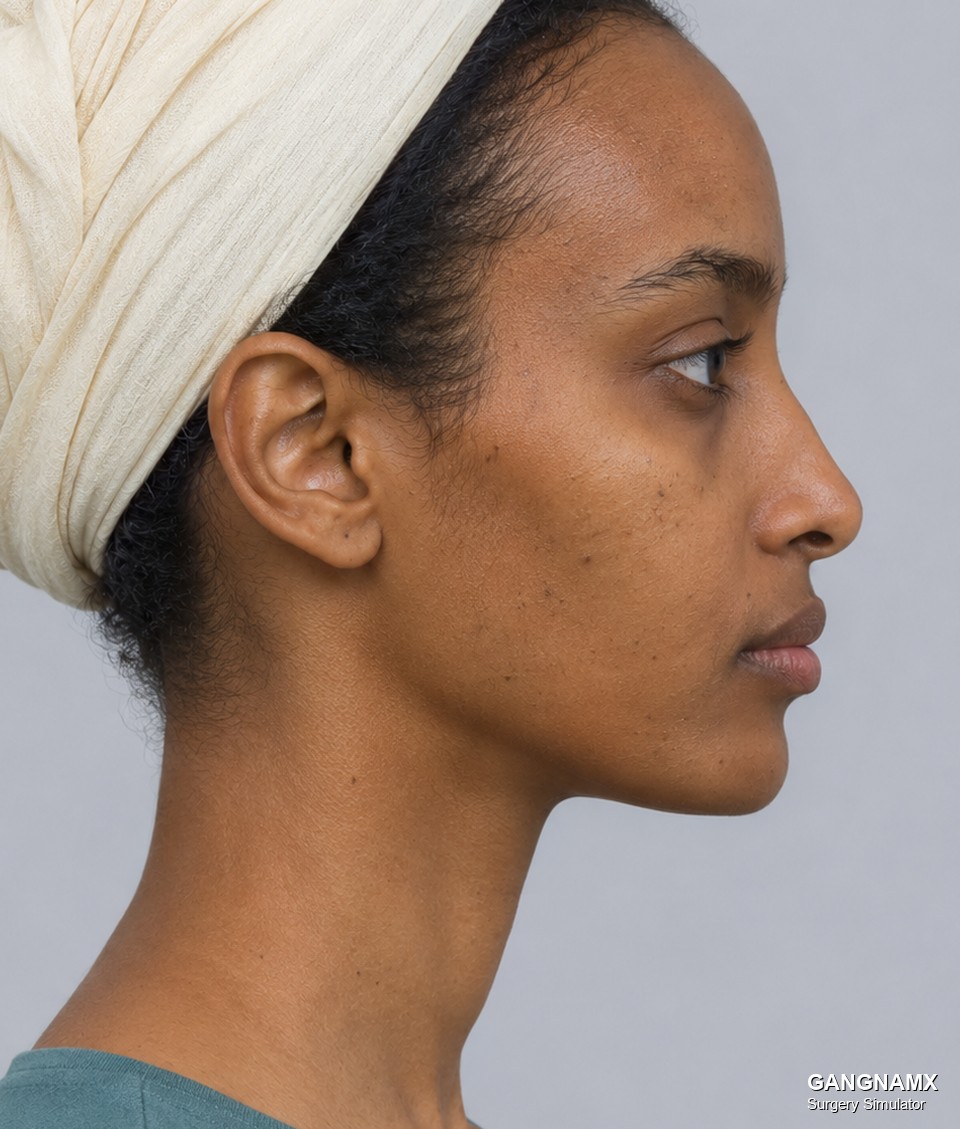
Notice how the change reads. The nose does not look different, yet the chin now sits visibly further forward and the whole line looks more settled because the lower third meets the nose in a steadier angle. This is why people sometimes dislike a profile while pointing at the nose, when the chin is what a specialist would raise first.
A forward move of the chin barely shows in a straight on view, which is one reason a mirror never explains what you feel in a side photo.
4. Compare the options and the uncertainties
Once you have named the part you dislike, there are broadly four paths. None is automatically right.
Do nothing, and change the way you photograph. Hold the phone at eye level, stand an arm length plus a little farther back, and use a mild zoom instead of moving close. Keep the chin level. This costs nothing and often resolves more than people expect.
Adjust one feature. If one part clearly stands out, a specialist can explain what that single change involves, how it interacts with the rest of the profile, and what recovery looks like. A small change to the chin affects how the nose reads, and the reverse is also true.
Adjust two features together. Some profiles work best when nose and chin are planned as a pair, so the line from brow to chin looks balanced. The trade off is a longer plan and a higher bar for a clear reason.
Wait. Dislike that comes and goes with mood, lighting or one unflattering picture is a signal to wait. A decision that holds after you have looked at many calm, accurate photos is a stronger one.
On uncertainty: a simulation is a preview of shape, not a promise. Healing, tissue and technique all shape a real result, and only a specialist who examines you in person can judge what is realistic. If you feel low, anxious or consumed by how you look, tell a doctor. That matters more than any profile.
5. Prepare before you book
Before a consultation, build a small set of materials. Take a true side photo at eye level with a friend holding the phone at normal distance, once on each side. Take a front photo and a three quarter photo in the same light. Pick the one part that bothers you most and write it as a sentence.
Bring these questions:
- Cause: Is my concern the nose, the chin, the neck line, or the photo angle?
- Balance: If one feature changes, how does the rest of my profile read afterward?
- Alternatives: Is there a non surgical or no change option worth considering first?
- Risks and follow up: What risks apply to the options we discussed, and what would recovery and check ups involve?
- Keeping my features: How would we refine the profile while keeping what makes my face mine?
Seeing the options on your own face first can make the conversation sharper, because you arrive with a view rather than a vague worry.
Simulation images by GangnamX.
 Plastic Surgery SimulatorEvery option, first.EyesNoseJawlineStart simulating